Do you want learn and know?

Posted by wyneman under

Technology is around everybody and you better believe you are not getting old just obsolete.

160 billion emails are sent daily, 97% of them are spam.

Spam generates 33bn KWt-hours of energy every year, enough to power 2.4 million homes, producing 17 million tons of CO2.

9 out of every 1,000 omputer are invected with spam.

Spammer get 1 response to every 12 million emails they send (yet it still makes them a small profit).

There are some 1 billion computers in use.

There are some 2 billion TV sets in use.

There are some 3 billion cell phone in use. About 3 million cell phones are sold every day.

The first known cell phone virus, Cabir.A, appeared in 2004.

Since 2008, video games have outsold movie DVDs.

About 1.6 billion people connect to the internet, 450 million of them speak English. See list of internet languages.

Google indexed it's 1 trillionth unique URL on July 25, 2008. That is thought to be about 20% of all the pages on the Internet but a high percentage of the World Wide Web (the public Internet).

One google search produces about 0.2g of CO2. But since you hardly get an answer from one search, a typical search sension produces about the same amount of CO2 as does boiling a kettle.
Google handles about 1 billion search queries per day, releasing some 200 tons of CO2 per day.

The average US household uses 10.6 megawatt-hours (MWh) electricity per year.

Google uses an estimated 15 billion kWh of electricity per year, more than most countries.
However, google generates a lot of their own power with their solar panels.

The first public cell phone call was made on April 3, 1973 by Martin Cooper.

The Motorola DynaTAC 8000X was the first cell phone sold in the US; launched on April 11, 1984, it was designed by Rudy Krolopp and weighed 2 pounds.

About 20% of the videos on YouTube is music related.

10 hours of video viewing is uploaded every minute on YouTube.

People view 15 billion videos online every month.

On average, US onliners view 100 videos per month each.

Flickr hosts some 3 billion photographs, FaceBook hosts more than 10 billion.


source : Did You Know?
Oh, those clever birds at Twitter. When the microblogging service announced recent changes to its terms of service, its executives knew exactly how to spin the news. For starters, media outlets dutifully went with headlines along the lines of "Twitter Changes TOS, Opens the Door for Ads," because in a blog post about the changes, Twitter founder Biz Stone chose to make the most noise about the possibility of advertising. Granted, the actual legal language was rather broad ("The Services may include advertisements, which may be targeted to the Content or information on the Services, queries made through the Services, or other information. The types and extent of advertising ... are subject to change."). A folksy "Tip," inserted on a nearby colored box, read: "We're leaving the door open for exploration in this area but we don't have anything to announce."


STONE: Can do whatever he wants with your content.
Such is the obsession with Twitter that sort-of news about possible maybe eventual news is ... big news.
Still, to fans of Twitter who want it to survive -- and who have been somewhat perplexed by what had almost begun to seem like an allergy to revenue -- the new ad-friendly stance was sort of a relief (if also an eventual presumed annoyance). Meanwhile, for those users who delved into more of Twitter's own take on its new TOS, there was the further revelation that the Twitter gang was, it seemed, definitively declaring that you own your own tweets. Also a relief! Right? Well, no.
The actual legal language reads: "You retain your rights to any Content you submit, post or display on or through the Services." But then it adds, "By submitting, posting or displaying Content on or through the Services, you grant us a worldwide, nonexclusive, royalty-free license (with the right to sublicense) to use, copy, reproduce, process, adapt, modify, publish, transmit, display and distribute such Content in any and all media or distribution methods (now known or later developed)." Yet another folksy "Tip" offers a friendly translation: "This license is you authorizing us to make your Tweets available to the rest of the world and to let others do the same. But what's yours is yours -- you own your content." Gosh, that "Tip" is so reassuring it actually does a pretty nice job of discouraging users from wandering back into the dense thicket of official legalese, where more clauses like this abound: "Such additional uses by Twitter, or other companies, organizations or individuals who partner with Twitter, may be made with no compensation."

Let's back up to February, when Facebook made changes to its TOS with similarly scary-broad references to possible reuse of material that users post or upload. It's somehow almost a quaint memory now, but at the time the Consumerist blog caused a media firestorm with a post titled, "Facebook's New Terms of Service: 'We Can Do Anything We Want With Your Content. Forever.'" Facebook was forced to clarify its intentions, declaring, for starters, that "We are not claiming and have never claimed ownership of material that users upload." (Twitter clearly learned a lesson vicariously.)
But the fact remains that Facebook, and now Twitter, have given themselves pretty wide-ranging rights to do what they please with what you upload, regardless of the fussy, quibbling technicality of "ownership." In fact, Twitter's weasely "on or through the Services" language -- what the hell does "or through" mean? -- seems designed to throw a particularly massive net over your content.

Why does this matter? Well, imagine if Facebook and Twitter were in transportation rather than social networking. Like, if instead of supplying you with a digital vehicle for your social-networking excursions, they were supplying you with an actual vehicle. Their lawyers would surely craft language that ("Tip"!) more or less means this:
You totally own your car -- it's yours! It belongs to you! -- but we can borrow it any time, we can paint it hot pink, we can rent it out to other people, we can put a giant Depend adult diaper ad on the hood and an "ACTIVIA KEEPS ME REGULAR!" bumper sticker on the back, we can fill the glove compartment with guacamole, and we can even poop in the trunk if we feel like it. ... But hey, it's YOUR car!
"Wait a second!," Twitter defenders might say. "Twitter's free, and we shan't look gift horses in the mouth!"
But the thing is, it's not free. As with Facebook, you power it by feeding yourself into its digital maw. It's called lifecasting because it's life-powered. For Twitter and Facebook to work, millions of people have to ritually sacrifice some greater or lesser portion of their actual personal lives (their inner thoughts morphing into public personas, and vice versa) -- in the form of random musings, expressions of affection and disdain, intimate details, memories, as well as often ridiculously revealing communications with friends, colleagues and strangers -- and of course they do. Post by post or update by update, it can feel merely tossed-off, negligible, but in aggregate more and more people are offering up goodly chunks of themselves.

When my colleague Michael Learmonth reported last week that Facebook is now making money, he wrote, "Key to Facebook's profitability has been its ability to keep its headcount low. [Facebook founder Mark] Zuckerberg points out in his blog post the company employs one engineer for every million users. The company has only 1,000 employees serving a user base that is quickly surpassing the population of the U.S."
How is that possible? Because YOU -- and 300 million others like you -- are doing all the goddamn heavy lifting!
And not only do you get no sweat equity in services like Facebook and Twitter, but they can poop in the trunk of your virtual car.
But hey, it's your virtual car, so drive safely ... and enjoy the ride

Google the Mistery doodle

Posted by wyneman under
 
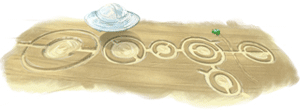
Google crop circle ... Martians at work?
One hundred and eleven years ago, HG Wells immortalised Horsell Common in Woking, Surrey as the setting for the first Martian landing in his classic novel The War of the Worlds. Today, the unassuming park was pinpointed by Google in what Twitter users believe to be a reference to the birthday of the father of science fiction.
At around 4am this morning, Google tweeted the latitude and longitude "51.327629, -0.5616088" and a link to today's crop circle "Google doodle", complete with a hovering flying saucer and a missing "l". The coordinates are situated on a road running past Horsell Common, which users of Twitter quickly realised was the location for one of the first and best known alien landings in science fiction.
"'It's out on Horsell Common now,'" Wells has one character exclaim. "'It's a cylinder – an artificial cylinder, man! And there's something inside … '"
That something turns out to be Martians, and hostile; "A big greyish rounded bulk, the size, perhaps of a bear, was rising slowly and painfully out of the cylinder. As it bulged up and caught the light, it glistened like wet leather," Wells wrote. "A lank tentacular appendage gripped the edge of the cylinder, another swayed in the air. Those who have never seen a living Martian can scarcely imagine the strange horror of its appearance."
Twitter users point out that the birthday of Wells – also the author of The Time Machine, The Invisible Man and The Island of Doctor Moreau – is just six days away, on 21 September, and believe the logo could be a "lead-up" to the anniversary, when Wells would have been 143 years old. Others point out that today in 1985 a Surrey family apparently saw a UFO on nearby Bagshot Heath.
The War of the Worlds has been adapted for television, film – in a number of versions, the most recent starring Tom Cruise – and radio: Orson Welles's 1938 adaptation caused mass panic in America when listeners took the fictional story at face value. Google's "mystery" appears to be causing similar excitement online today.
Google is developing a product called Fast Flip that aims to make it simpler and faster to browse through news articles on the Web, a process that the company finds is cumbersome and discourages people from reading more online.


Fast Flip was expected to go live late Monday at the Google Labs Web site, where the company features early stage product prototypes. As such, Fast Flip could change significantly, become temporarily unavailable or even disappear without notice.
Fast Flip lets readers glance at pages and browse through them quickly without having to wait for multiple page elements to load, which can significantly slow the rendering of articles, especially if they have multimedia content, according to Google.
The idea is to try to replicate online the ease with which people flip through the pages of print magazines and newspapers in the offline world. This could motivate people to read more online, which Google argues will help publishers attract more readers and increase their revenue.
However, when users click on a Fast Flip link, they will be taken to the corresponding publisher's Web site, where the Google technology will not be on hand to display the page more quickly.
People who try out Fast Flip will find articles from 36 publishers, including The New York Times, the Washington Post, Salon and Newsweek, as well as contextually relevant ads. For now, Fast Flip will only feature content from the publishers Google has been working with to develop the technology, but it plans to add more in the future.
Fast Flip will also feature a search engine and let users share content. Based on their reading choices, users will see suggestions for other articles they might find interesting.
At this point, Google isn't making any tools available for external developers to integrate Fast Flip with their Web sites and applications.
"Launching Google Fast Flip in Labs lets us learn from our users and our publishing partners so we can keep exploring ways to display news and help publishers make more money from their content," a spokesman for Google said via e-mail.
"We know that Google Fast Flip isn't perfect, and there's a chance it may never become a full-blown Google product. But we think there are some interesting ideas behind it," he added.
In addition to working on regular PC browsers, the Fast Flip Web site adapts itself when reached from iPhone and Android-based mobile devices, letting users flip pages via a touch-screen interface. Google was due to unveil Fast Flip at the TechCrunch 50 Conference in San Francisco.

http://www.kk.org/thetechnium/barilan_internet-thumb.jpg
Internet (comúnmente conocido como "red de redes") es un método de interconexión descentralizada de redes de computadoras implementado en un conjunto de protocolos denominado TCP/IP y garantiza que redes físicas heterogéneas funcionen como una red lógica única, de alcance mundial. Sus orígenes se remontan a 1969 , cuando se estableció la primera conexión de computadoras, conocida como ARPANET , entre tres universidades en California y una en Utah. 
Al contrario de lo que se piensa comúnmente, Internet no es sinónimo de World Wide Web (WWW, o "la Web"). Ésta es parte de Internet, siendo uno de los muchos servicios ofertados en la red Internet. La Web es un sistema de información mucho más reciente, desarrollado inicialmente por Tim Berners Lee en 1989 . El WWW utiliza Internet como medio de transmisión .
Algunos de los servicios disponibles en Internet, aparte de la Web, son el acceso remoto a otras máquinas ( SSH y telnet ), la transferencia de archivos ( FTP ), el correo electrónico ( SMTP y POP ), los boletines electrónicos ( news o grupos de noticias ), las conversaciones en línea ( IRC y chats ), la mensajería instantánea y la transmisión de archivos ( P2P , P2M , Descarga Directa ).
Internet incluye aproximadamente 5000 redes en todo el mundo y más de 100 protocolos distintos basados en TCP/IP, que se configura como el protocolo de la red. Los servicios disponibles en la red mundial de PC , han avanzado mucho gracias a las nuevas tecnologías de transmisión de alta velocidad, como DSL y Wireless , se ha logrado unir a las personas con videoconferencia, ver imágenes por satélite (ver tu casa desde el cielo), observar el mundo por webcams, hacer llamadas telefónicas gratuitas, o disfrutar de un juego multijugador en 3D , un buen libro PDF , o álbumes y películas para descargar. 
 
El método de acceso a Internet vigente hace algunos años, la telefonía básica , ha venido siendo sustituida gradualmente por conexiones más veloces y estables, entre ellas el ADSL , Cable Módems, o el RDSI . También han aparecido formas de acceso a través de la red eléctrica , e incluso por satélite (generalmente, sólo para descarga, aunque existe la posibilidad de doble vía, utilizando el protócolo DVB -RS).
Internet también está disponible en muchos lugares públicos tales como bibliotecas , hoteles o cibercafés . Una nueva forma de acceder sin necesidad de un puesto fijo son las redes inalámbricas , hoy presentes en aeropuertos , universidades o poblaciones enteras. 
fuente Wikipedia