The Puerto Rico earthquake of May 16, 2010, occurred in an inclined seismic zone that dips south from the Puerto Rico Trench and that consists of subducted lithosphere of the North America plate. The broad-scale tectonics of the Puerto Rico region are determined by the motion of the Caribbean plate east-northeast at a velocity of about 20 mm/yr with respect to the North America plate. The North America plate is thrust beneath the Caribbean plate at the Puerto Rico Trench, and is seismically active to depths of about 150 km.
Earthquakes, such as this one, that have focal-depths between 70 and 300 km are commonly termed "intermediate-depth" earthquakes. Intermediate-depth earthquakes typically cause less damage on the ground surface above their foci than is the case with similar magnitude shallow-focus earthquakes, but large intermediate-depth earthquakes may be felt at great distance from their epicenters.

ftp://hazards.cr.usgs.gov/maps/sigeqs/20100516/20100516.jpg
http://earthquake.usgs.gov/earthquakes/eqarchives/poster/2010/20100516.medium.jpg


Magnitude5.8
Date-Time
Location18.400°N, 67.070°W
Depth113 km (70.2 miles)
RegionPUERTO RICO
Distances
  • 5 km (3 miles) E (82°) from Moca, PR
  • 5 km (3 miles) S (184°) from Aceitunas, PR
  • 7 km (4 miles) NW (323°) from Hato Arriba, PR
  • 64 km (40 miles) NW (312°) from Ponce, PR
  • 99 km (62 miles) W (265°) from SAN JUAN, Puerto Rico
Location Uncertaintyhorizontal +/- 1.7 km (1.1 miles); depth +/- 1 km (0.6 miles)
ParametersNST= 31, Nph= 31, Dmin=8.6 km, Rmss=0.27 sec, Gp=104°,
M-type=regional moment magnitude (Mw), Version=5
Source
Event IDpr10136002


Source  United States Geological Survey’s (USGS) Earthquake Hazards


Atlantis' Final Mission

Posted by wyneman under

 
http://www.nasa.gov/images/content/446691main_sts132s001_226.jpg
 
05.14.10
source NASA.ORG
Kennedy Space Center
Cape Canaveral, Florida, east of Orlando

The STS-132 mission patch features Atlantis flying off into the sunset as the end of the Space Shuttle Program approaches. However, the sun is also heralding the promise of a new day as it rises for the first time on a new International Space Station module, the Russian Rassvet Mini-Research Module-1. Photo Credit: NASA
After almost 25 years and more than 115 million miles, space shuttle Atlantis is down to just one final mission – but it will be going out on a high note.

STS-132 will deliver to the International Space Station the Russian Rassvet Mini-Research Module-1, only the second Russian module to ever be carried into space by a space shuttle. It’s a fitting final payload for the orbiter that not only launched the first into space, but also was the first shuttle to dock to the Russian Space Station Mir – in fact, Atlantis was the shuttle behind seven of the 11 shuttle missions to Mir.

"Atlantis has a history of being the shuttle that did the most international things," said Emily Nelson, lead space station flight director for the mission. "It’s the orbiter that the Russians have known best, because it’s one that came to their space station most often, and it’s one that we used to deliver a module for them in the past."

Whether or not they recognize it by name, many people are likely familiar with Atlantis’ work. Besides the visits to Mir, Atlantis carried the Magellan Spacecraft into orbit, sending it on its way to Venus, where it mapped 98 percent of the plant from orbit. The same year – 1989 – it also deployed the Galileo Spacecraft to Jupiter, where it collected data on the planet and its moons for eight years.

Closer to home, Atlantis has visited the International Space Station 10 times – STS-132 will be its 11th trip – delivering among other pieces of hardware, the United States’ Destiny Laboratory and Europe’s Columbus. And just last year it made the final flight to the Hubble Space Telescope, bringing upgrades that should allow the telescope to see further into the universe than ever for years to come.

"Atlantis has clearly been a work horse of the space shuttle fleet over the years," said Mike Sarafin, lead STS-132 shuttle flight director. "The shuttle program history is pretty complicated, but I think it will show that Atlantis is a remarkable vehicle."

But Atlantis is not finished making history just yet – there are still a few firsts in store.


For instance, the installation of Rassvet. Normally when a new piece of the space station is installed, all the work is done (the hooks are engaged and the latches latched to attach the new module to the rest of the station) from the space station side of the equation. That’s true for all of the international partners involved in the station except for Russia. Until now, the Russian modules have all been launched into space on their own, not carried up by a space shuttle, and the Russian system makes use of that by relying on the momentum of the new module as it approaches to force the latches.

That won’t be possible this time around. Instead, the STS-132 crew will use the space station’s robotic arm to attach it. The arm will be extended to just about its full 58 feet to reach Rassvet’s home on the Zarya module, which will make it difficult to push with much force. In addition, the commands to the module to work those latches and hooks will have to take a long circuitous route from the robotic arm controls inside the Cupola, through the United States segment of the station to the Russian segment, then back to the United States segment and out through the robotic arm to the Rassvet.

"Installing that module is going to be an interesting day," STS-132 Commander Ken Ham said. "If anything goes wrong in this delicate plan, we have to get it to work right. We think, based on the analyses, that we’re going to be just fine. However, we’re prepared for all sorts of problems that could arise getting that thing in there."

If the team is lucky, some of Atlantis’ good luck will rub off on the module while it’s in the shuttle’s cargo bay, and the installation will go off without a hitch – Atlantis tends to be the member of the shuttle fleet with the fewest problems in flight, so it wouldn’t be out of character.

"Like any home or any car that you’ve had over the years, the shuttles have their nuances," Sarafin said. "Atlantis tends to behave very well when it’s flying. That’s a nice luxury to have."


Apple's new multimedia tablet device, with a 10-inch touch screen that is expected to deliver video, text, navigation and social-networking applications, is trying to change the way much of traditional media is delivered.

Apple Tablet Launch Today the Kick Off  1PM ET

for more details click here
Los Tres Reyes Magos literally means "The Three King Wizards", but is usually interpreted to mean "The Three Wise Men" or "The Three Kings".  Their celebration day (January 6th)  is refered to as "Three Kings Day" or just "The Day of the Kings".
As you may know the Three Kings, Balthasar (Spanish = Baltasar), Gaspar and Melchior (Spanish = Melchor) arrived twelve days after the birth of Jesus, bearing their famous gifts of gold, and frankincense and myrrh. 
As such in Spain, this is the day that people give and receive gifts.   And as children in the United States and other countries might wait with great anticipation the arrival of Santa Claus, in Spain the children await the arrival of the Three Kings.

On January 5th in most Spanish and Puerto Rico towns is the "la cabalgata or La premesa de Reyes" (the calvacade The Vow) which is a parade marking the arrival of the Three Kings.  The Three Kings ride on floats throwing candy to the children.  In the Canary and Balaeric Islands the Three Kings arrive by ship!  

After the parade the children return to their homes to prepare for the arrival of the Three Kings.  They place their shoes on the windowsills and fill them with straw, carrots and barley for the donkeys or Camels of the Three Kings.  Sometimes they might also leave some food for the Three Kings.  The next morning the children wake up early to open their presents. Although the children like all of the Three Kings, their favorite is Baltasar because he is the one who it is believed actually leaves the gifts.  This is also the day that adults will get their presents although of course these are not delivered by the Three Kings.


Mystery of the Three KingsThree Kings (Snap Case)Dora the Explorer: Dora Celebrates Three Kings Day!A Tale of three Kings: A Study in Brokenness 

Source: Spanish and Latin Culture Festivities 
Magical things happen once upon a Blue Moon. And this Thursday we get a chance to find out just what those magical things as we watch the rare lunar event coincide with all the beautiful fireworks of New Year's Eve.
Blue Moon is the term applied to the second full Moon in a calendar month. It's an event that occurs roughly every two and a half years. This Thursday's blue Moon is far rarer than that though, because it's happening right on New Year's Eve—a coincidence that happens only about once in every twenty years.


No, the Moon doesn't actually turn blue. It's just the term used to describe this lunar event.

December’s Full Moon is traditionally known as the Old Moon, or the Moon after Yule. And on New Year's Even we’re going to call it Blue. No matter what it is referred to, it is still a lovely sight to watch it rise in its grey-scale glory and glide across the luminous night sky. But for some lucky viewers in much of Europe, Africa, Asia, and Australia the Old Blue Moon after Yule will also partially eclipse!

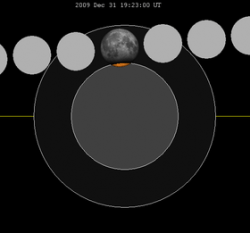
280px-Lunar_eclipse_chart_close-2009Dec31 Only a very small portion of the Moon's southern limb will be in the Earth's umbral shadow, but there will be a noticeable darkening visible over the Moon's face at the point of greatest eclipse. Need more? Then know this eclipse is the one of four lunar eclipses in a short-lived series. The lunar year series repeats after 12 lunations or 354 days. Afterwards it will begin shifting back about 10 days in sequential years. Because of the date change, the Earth's shadow will be about 11 degrees west in sequential events.
For the eclipse, the duration of the partial phase will last within two seconds of a hour long, while the penumbral duration from beginning to end will run about four hours and eleven minutes. Penumbral contact will begin at 17:17:08 UT and umbral contact at 18:52:43 UT. The moment of greatest depth of shadow will occur at 19:22:39 UT, 31 December 2009. It will be visible from all of Africa, Europe, Asia, and Australia.


Canon Digital Rebel XSi 12.2 MP Digital SLR Camera with EF-S 18-55mm f/3.5-5.6 IS Lens (Black)   EyeClops Night Vision Infared Stealth Goggles V2 Celestron 21037 PowerSeeker 70EQ Telescope
 
source; gizmodo, universe today all rights are reserve
I must say Christmas is one of my favorite times of the year. It's a time when all our friends and family get together and celebrate. But what are we celebrating and why? Many people don't have a clue where Christmas comes from or why we even celebrate it. Well I am going to attempt to explain it and give people a better understanding of it. It not just about Charlie brown, Christmas trees, stockings, light and presents. Even though that's what we associate with Christmas.

Where did the word come from: The Christmas story is the story of the birth of Jesus Christ in the town of Bethlehem, Israel. Jesus "Christ" is known as the founder or central figure of "Christianity." Christmas is a Christian holiday on December 25 that commemorates the birth of Jesus. Ancient Romans also commemorated Jesus' birth by marking a division of the calendar still in use today. Christmas literally means the Mass (celebration) of Christ. "Christ" is a Greek word and title, meaning "anointed" or one set apart by God for a special purpose. "Christ" is equivalent to the Hebrew word "messiah" Based on the words of ancient prophets, the first century Jewish people expected the arrival of the Messiah promised by God as a great deliver of the people.
Where did all the stuff for Christmas come from?


From November onwards, it is impossible to forget that Christmas is coming. Colored lights decorate many town centers and shops, along with shiny decorations, and artificial snow painted on shop windows. In streets and shops, 'Christmas trees' (real or plastic evergreen 'conifer' trees) will also be decorated with lights and Christmas ornaments. The custom of sending Christmas cards started in Britain in 1840 when the first 'Penny Post' public postal deliveries began. (Helped by the new railway system, the public postal service was the 19th century's communication revolution, just as email is for us today.) As printing methods improved, Christmas cards were produced in large numbers from about 1860. They became even more popular in Britain when a card could be posted in an unsealed envelope for one halfpenny - half the price of an ordinary letter. Traditionally, Christmas cards showed religious pictures - Mary, Joseph and baby Jesus, or other parts of the Christmas story. Today, pictures are often jokes, winter pictures, Father Christmas, or romantic scenes of life in past times.


What about the man in the red suit:
Father Christmas is based on a real person, St. Nicholas, which explains his other name 'Santa Claus' which comes from the Dutch 'Sinterklaas'. Nicholas was a Christian leader from Myra (in modern-day Turkey) in the 4th century AD. He was very shy, and wanted to give money to poor people without them knowing about it. It is said that one day, he climbed the roof of a house and dropped a purse of money down the chimney. It landed in the stocking, which a girl had put to dry by the fire! This may explain the belief that Father Christmas comes down the chimney and places gifts in children's stockings.
So this was just a short version of where Christmas came form, but there are lots of other info form where it originated and why we do some of the things we do in the spirit of Christmas.


History of Thanksgiving


For thousands of years, mankind has set aside a day each year to celebrate bountiful annual harvests. Before the establishment of formal religions, many ancient farmers believed that their crops contained spirits which caused the crops to grow and die. Many believed that these spirits would be released when the crops were harvested and they had to be destroyed or they would take revenge on the farmers who harvested them. Some of the harvest festivals celebrated the defeat of these spirits. Harvest festivals and Thanksgiving celebrations were held by the ancient Greeks, the Romans, the Hebrews, the Chinese, and the Egyptians. 

What is the history of Thanksgiving in United States? The initial "Thanksgiving" feast, held in 1621, was really a traditional English harvest celebration. The Pilgrims shared it with the Native Americans because they had taught the colonists to plants crops and hunt wild game. Without the Native Americans, the Pilgrims may not have survived the harsh winter and been able to celebrate their first harvest of plentiful crops in the New World. The colonists' first harvest feast lasted for three days. Food was served all at once, instead of in courses, so people ate whatever they pleased in the order that they desired.

The more important members at the feast were given the best pieces of meat, while the rest of the diners ate whatever was closest to them. Since the Pilgrims didn't use forks or plates, they ate their meal straight off the table with spoons, knives or their fingers. They used large napkins to wipe their hands and also wrapped it around food when it was too hot to hold.
The history of Thanksgiving demonstrates that feasts like the one at Plymouth were held throughout the colonies after fall harvests. However, all thirteen colonies did not celebrate Thanksgiving at the same time. In 1789, George Washington became the first president to declare Thanksgiving a holiday.
By the mid-1800s, many states observed the Thanksgiving holiday. Meanwhile, the poet and editor, Sarah J. Hale, had begun lobbying for a national Thanksgiving holiday. During the Civil War President Abraham Lincoln looking for ways to unite the nation, discussed the subject with Hale. In 1863 he gave his Thanksgiving Proclamation declaring the last Thursday in November a day of Thanksgiving.


Thanksgiving Day is observed in both the US and Canada. While it falls on the fourth Thursday in November in the US, Thanksgiving is celebrated on the second Monday in October in Canada.

Thanksgiving Day is also called Turkey Day, T-Day, Macy's Day and Yanksday.
The significance of the holiday is to be thankful for what one has in life.
Traditionally, Thanksgiving holiday is celebrated with a big dinner shared among family and friends.

It's considered an important annual family gathering in both Canada and the US. It's usual for people to travel long distances just to be home in time for the celebration.

The star of the dinner is the large roasted turkey. And since turkey is the most common main dish during a Thanksgiving dinner, therefore Thanksgiving is also called Turkey Day.
Of course, besides feasting, let's remember to express your gratitude for the blessings in your life.

When you're grateful and thankful, it opens the door for more blessings to flow into your life.

source pic and script Walt Disney Enterprise,  Wikipedia

Too much water dangerous?

Posted by wyneman under


Water can cause the brain to swell
A Californian woman has died after taking part in a water-drinking contest, but why is too much water dangerous?

We are regularly advised to drink more water: it clears skin, reduces tiredness and aids concentration.
But the death of a woman in the US after taking part in a water-drinking contest shows you can have too much of a good thing.
Jennifer Strange had taken part in the "Hold Your Wee for a Wii" game, which promised the winner a Nintendo Wii. Afterwards she reportedly said her head was hurting and went home, where she was later found dead. Initial tests have shown her death is consistent with water intoxication.
Drinking too much water can eventually cause your brain to swell, stopping it regulating vital functions such as breathing, and causing death. So what happens?


Water enters the body when we drink and is removed primarily in the urine and sweat. The amount of water in the body is regulated to control the levels of certain compounds, such as salt, in the blood.
If you drink too much water, eventually the kidneys will not be able to work fast enough to remove sufficient amounts from the body, so the blood becomes more dilute with low salt concentrations.
"If you drink too much water it lowers the concentration of salt in your blood so that it is lower than the concentration of salt in cells," says Professor Robert Forrest, a consultant in clinical chemistry and forensic toxicology at the Royal Hallamshire Hospital in Sheffield.


Confusion
The water then moves from the dilute blood to the cells and organs where there is less water. Professor Forrest likens this to the effects seen in science-class experiments.

"If you put salty water on onion skin the cells will shrink, if you put too much water on it the cells will swell," he says.
This swelling is a problem in the brain
.
"When the brain swells, it is inside a bony box so has nowhere to go," he says. "The pressure increases in the skull and you may get a headache. As the brain is squeezed it compresses vital regions regulating functions such as breathing."
Eventually these functions will be impaired and you are likely to stop breathing and die. Warning signs included confusion and headaches.
Symptoms would normally occur very soon after drinking the water, but if the gut is absorbing the water more slowly then it can take longer.
Drinking several litres over a relatively short period of time could be enough to cause water intoxication. Those most at risk include people taking ecstasy, as the drug increases thirst and facilitates the release of anti-diuretic hormones so more water is taken in but cannot be excreted. Also, elderly people because their kidney function may be impaired.
Treatment for drinking excess water is "relatively straightforward", says Professor Forrest. It includes giving patients diuretics to help decrease their water load, or using drugs to reduce the swelling caused by excessive water.


Hot
He says the real problem is diagnosis. Because patients can be very confused they are often mistakenly thought to have taken drugs.
Ursula Arens, of the British Dietetic Association, says water is essential for a variety of bodily functions, for example to excrete waste products such as urea.
We lose water all the time and so need to replace it and in normal circumstances should aim to drink about one and a half litres every day, she says. During hot weather or exercise more should be consumed as dehydration can lead to bad breath, tiredness and a higher risk of bladder infections.
"If you are going to the toilet more than once every two hours or so that might be too much, especially if your urine is clear," she says, but adds that drinking too much water is unusual.

Below is a selection of your comments.
A partner of mine was a nurse, and I remember him telling me over 20 years ago that "The poison is the dose". This death illustrates the truth of that statement as clear as a bell.
Stephen Watson, Brighton, UK
I believe that when drinking too much water, the water is absorbed into the red blood cells which causes them to swell also, so if there is too much water, there is a possiblity that the red blood cells will explode.

source BBC Magazine